
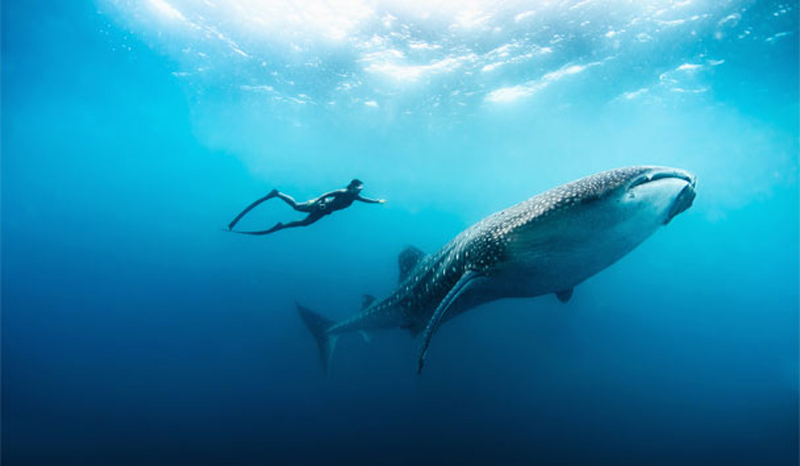
Freediving and scuba diving offer completely different experiences when it comes to wildlife encounters. Neither is universally better—it depends on the animal, conditions, and what you're trying to achieve.
Freediving means breath-hold diving with minimal gear: mask, snorkel, fins, and sometimes a wetsuit. You surface-swim, take a breath, and dive down for 30 seconds to 2 minutes before returning to the surface.
Best for: Whales (humpbacks, orcas), whale sharks, manta rays, dolphins, sea lions, and other surface-oriented megafauna.
Why it works: Many marine mammals and large pelagics are more comfortable with freedivers than scuba divers. No bubbles means less noise, less visual disruption, and animals often approach closer out of curiosity. Freediving lets you move fluidly and quietly, making you seem less threatening.
Whale encounters almost always favor freediving. Humpback whales in Tonga, orcas in Norway, and sperm whales in Dominica are all accessed via freediving because scuba bubbles disturb them. Surface swimming with snorkel and fins gives you mobility to keep up with fast-moving animals.
Downsides: You're limited by breath-hold time. If the animal dives deep or moves quickly, you can't follow for long. Physical fitness matters more—you need lung capacity, swimming strength, and comfort in open water.
Scuba gives you extended bottom time at depth with compressed air. You can stay underwater for 45-60 minutes (or longer with proper training), observe animals at their depth, and maintain neutral buoyancy.
Best for: Reef sharks, hammerheads, manta rays at cleaning stations, sea turtles, octopuses, and anything that lives at depth or stays stationary.
Why it works: Scuba lets you position yourself at cleaning stations where mantas and sharks come to you. You can wait quietly on the reef while animals go about their behavior naturally. For encounters like hammerhead aggregations in Galapagos or tiger sharks in Bahamas, scuba is the only realistic option because these happen at 15-30 meters.
Scuba also works better in low-visibility conditions where you need to get closer to subjects. Freediving in murky water is frustrating—you surface every 30 seconds and can't see anything. Scuba lets you stay at depth where visibility might improve.
Downsides: Bubbles spook some animals, especially marine mammals. You're less mobile—heavy tank and BC limit your ability to swim fast or surface quickly. Boat logistics are more complex (gear, fill stations, bottom time limits).
Humpback whales: Freediving only. Scuba bubbles disturb them, and they surface-orient, making breath-hold swimming ideal.
Orcas: Freediving only. Same reasoning—bubbles disrupt their hunting and behavior.
Whale sharks: Freediving preferred, but scuba works if you're at a cleaning station where they linger. Most encounters happen at the surface, making snorkel and fins more practical.
Manta rays: Both work. Freediving for surface feeding aggregations (Hanifaru Bay). Scuba for cleaning stations where they hover at 10-20 meters.
Hammerhead sharks: Scuba only. They aggregate at depth (15-30m), and you need to stay down to observe them.
Reef sharks: Scuba preferred. They're comfortable around divers, and you want bottom time to watch natural behavior.
Sea turtles: Both work equally well. Turtles don't care about bubbles and are accessible at snorkel depth or on scuba.
Freediving requires fitness, breath-hold training, and comfort in open water. You're swimming constantly, managing fatigue, and timing dives. Beginners can snorkel at the surface, but duck-diving to interact with animals takes practice.
Scuba requires certification and experience managing equipment underwater. Easier physically than freediving (less swimming), but more complex logistically (tanks, weights, buoyancy control).
Freediving is cheaper. Minimal gear (mask, snorkel, fins) costs $100-300. No air fills, no expensive BC or regulator. Freediving-focused tours (Tonga whales, Norway orcas) cost $3,000-5,000 for week-long trips, comparable to scuba liveaboards.
Scuba requires more investment: full gear setup runs $1,500-3,000, plus certification courses ($400-600). Liveaboards and dive resorts cost similar to freediving trips, but you're paying for tank fills and dive operations daily.
Freediving risks: Shallow water blackout if you push breath-holds too hard. Always dive with a buddy. Don't hyperventilate before dives. Know your limits and surface with air to spare.
Scuba risks: Decompression sickness, barotrauma, equipment failure. Requires training and strict adherence to dive tables or computers. Never hold your breath on scuba.
Both require ocean awareness: currents, weather, boat traffic, and animal behavior. Guides and tour operators manage most risks, but personal responsibility matters.
For whales and orcas: Freediving is the only option.
For whale sharks and mantas: Freediving works best, though scuba has niche uses.
For sharks and reef life: Scuba gives you more time and better positioning.
For flexibility: Learn both. Many wildlife-focused travelers do freediving for megafauna and scuba for reef encounters.
If you're starting from scratch and only want one skill, freediving opens more doors for charismatic megafauna (whales, whale sharks, orcas), which are often the most sought-after encounters. Scuba gives you access to deeper ecosystems and longer observation time.
Ideally, do both. They complement each other, and the best wildlife destinations often require both skill sets to maximize opportunities.
.png)


.svg)