
The choice between freediving and scuba diving for marine wildlife photography depends on what you're shooting, where you're shooting it, and what kind of images you want to create.
Silence is the biggest advantage. No bubbles, no mechanical noise, no hissing regulators. Marine animals are far less spooked by a quiet freediver than a bubble-producing scuba diver. This matters especially for skittish species like dolphins, sharks, and pelagics.
Mobility is the second advantage. You can drop down, take shots, surface, reposition, and repeat quickly. No decompression limits, no bottom time calculations, no tank weight. You're light, fast, and agile.
Approach angles are better. Many of the best wildlife shots require shooting up from below or getting low and shooting level. Scuba divers create bubbles that rise and disturb animals above them. Freedivers can approach from below without that issue.
Natural light works better at shallow depths. Most freediving happens in the 5-20 meter range where sunlight still penetrates well. Colors stay vibrant without heavy artificial lighting.
Time is limited. Even experienced freedivers only get 1-3 minutes per dive, often less when you factor in descent, positioning, and shooting. This makes patient wildlife photography difficult. You get brief moments, not extended sessions.
Depth is restricted. Recreational freediving rarely exceeds 30 meters, and most wildlife photography happens shallower. Deep-dwelling species or animals that prefer depths beyond 40 meters are out of reach.
Gear is minimal. You're limited to what you can carry and operate while breath-holding. That typically means a compact camera or mirrorless in a housing, maybe a small strobe. Large professional setups with dual strobes and heavy lenses become impractical.
Physical demand is high. Freediving requires fitness, training, and comfort with breath-holding. Not everyone can do it, and fatigue sets in quickly when you're diving repeatedly throughout the day.
Time is unlimited (within no-decompression limits). You can spend 30-60 minutes on a single dive, waiting patiently for the right moment, observing behavior, and taking hundreds of shots. This is crucial for macro photography or when photographing cautious animals that need time to adjust to your presence.
Depth access is greater. Scuba opens up depths to 40+ meters safely. Deep reefs, wrecks, and pelagic species that cruise deeper water become accessible.
Gear flexibility is total. You can shoot large mirrorless systems with dual strobes, wide-angle domes, and heavy lighting setups. The water supports the weight, so you're not limited by what you can physically manage while freediving.
Stability is better for macro work. Hovering motionless for macro shots is easier with scuba. Neutral buoyancy lets you hold position and frame tiny subjects precisely. Freediving makes this nearly impossible since you're constantly sinking or surfacing.
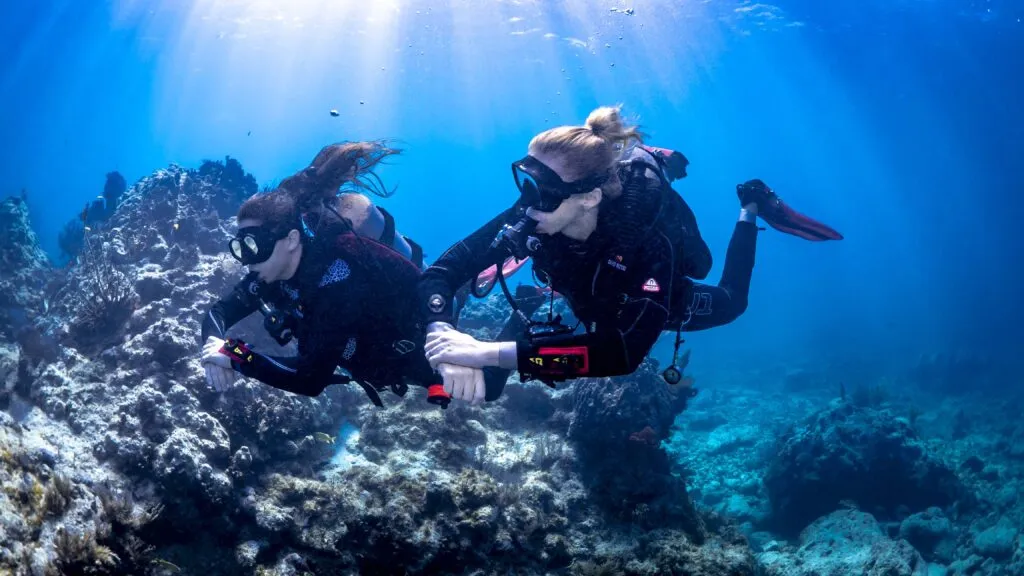
Bubbles scare animals. The noise and visual disturbance from exhaust bubbles make close approaches difficult with many species. Sharks, rays, and cetaceans often keep distance from scuba divers.
Bulk and weight reduce mobility. Scuba gear is heavy and cumbersome. Quick repositioning, fast ascents and descents, and chasing mobile animals become difficult. You're slower and less maneuverable than freedivers.
Training and cost are higher. Scuba requires certification, rental or ownership of equipment, tank fills, and often boat fees. Freediving just needs fins, mask, and a wetsuit.
Pelagics (sharks, dolphins, whales, tuna): Freediving wins. These animals are sensitive to bubbles and move quickly. Freediving's silence and mobility make encounters more likely.
Macro (nudibranchs, shrimp, small reef creatures): Scuba wins. You need time and stability to nail focus on tiny subjects. Freediving doesn't give you either.
Reef scenes and landscapes: Scuba wins. You want time to compose, adjust lighting, and wait for fish to move into frame. Scuba's extended bottom time helps.
Manta rays and whale sharks: Freediving wins. These gentle giants are approachable but prefer quiet swimmers. Snorkeling depth (0-10m) suits freediving perfectly.
Wrecks and deep reefs: Scuba wins. Depth access is essential, and you need time to explore and compose shots in complex environments.
Yes, and many professional underwater photographers do. Use freediving for pelagic encounters and fast-moving wildlife. Use scuba for macro work, reef documentation, and deep subjects. Match the technique to the subject and conditions.
If you're just starting, learn scuba first. It's more accessible, safer for beginners, and gives you a foundation in underwater photography basics. Add freediving later when you're comfortable underwater and ready to chase more challenging subjects.
.png)


.svg)