
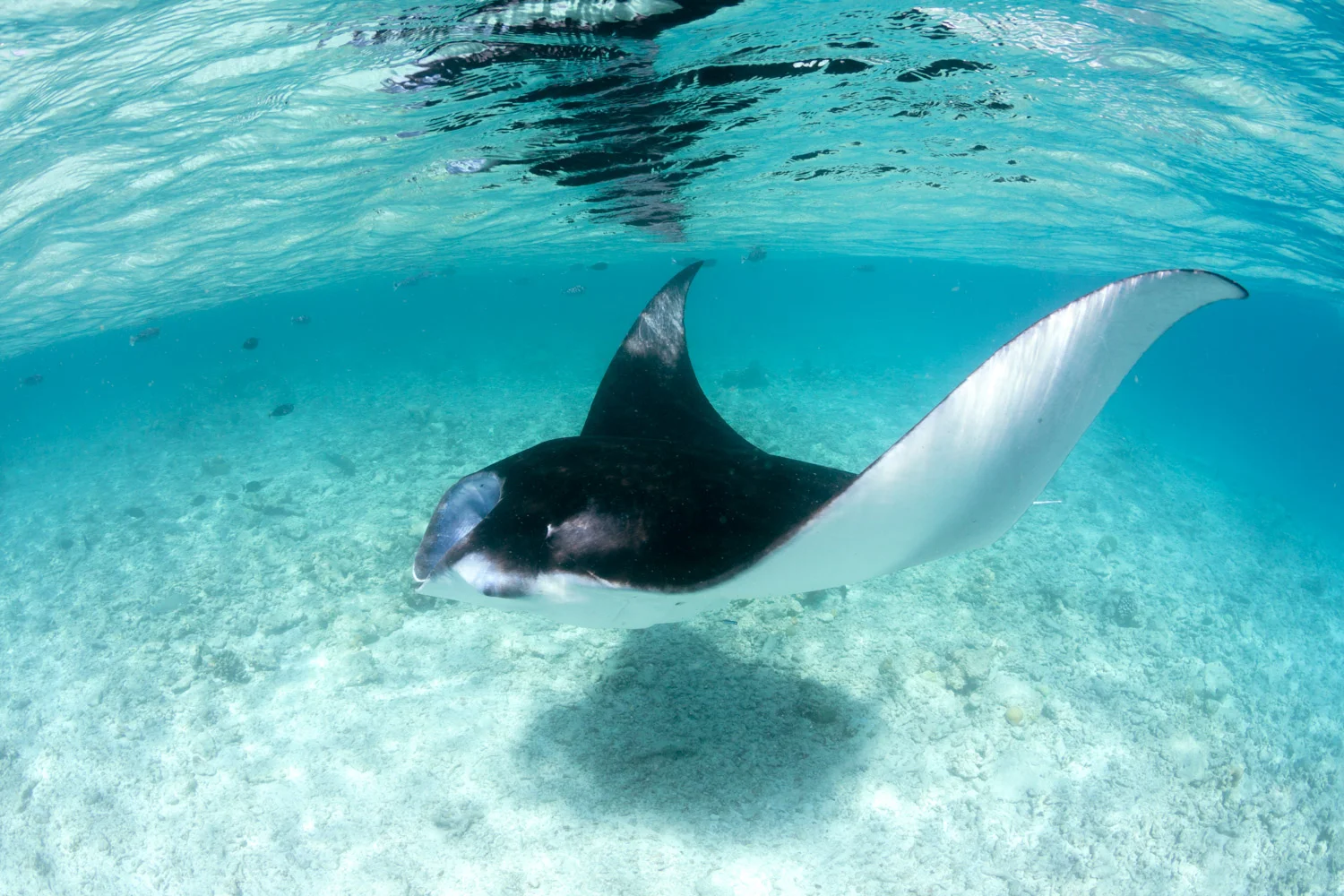
Here's something nobody tells you before your first manta encounter: the technique that gets you closest to a manta is the opposite of what your instincts will tell you to do.
Every impulse will be to swim toward them, to dive down, to keep up. Mantas respond to that by gliding effortlessly out of range. The swimmers they come back to are the ones floating motionless on the surface, face down, barely moving. That stillness reads as non-threatening. Sometimes it reads as interesting. And occasionally, a manta will come up from below and pass so close you could almost reach out — except you don't, because touching them removes the protective mucus on their skin, and because the moment you reach you've broken the spell anyway.
You don't need to be a strong swimmer. You need to be comfortable enough in the ocean that you're not spending your mental energy managing anxiety. Basic snorkeling — floating face-down, breathing calmly through a snorkel, wearing fins — is the whole skill set. If you've snorkeled in a bay or a pool before, you have what this requires.
The more important thing is patience. Manta encounters don't always happen immediately. Sometimes you're in the water for twenty minutes before anything arrives. The people who get the best encounters are the ones who can wait without fidgeting.
Watching a manta feed is one of the more extraordinary things you can witness in the ocean. They use their cephalic fins — the horn-like structures on either side of their mouths — to funnel plankton-rich water in as they swim. When plankton is concentrated, they do barrel rolls, looping continuously through the same patch of water to pass through it repeatedly. At places like Hanifaru Bay in the Maldives during peak season, you'll see dozens of mantas doing this simultaneously, spiraling through each other in what looks like slow-motion choreography.
Cleaning stations are different. Mantas hover almost motionless over a coral structure while small wrasse and other cleaner fish remove parasites. At these stations, they're unusually accessible — staying in one spot for minutes at a time, sometimes much longer, while the cleaning happens. These are the encounters where a manta will simply be there, at eye level, for as long as you're willing to float alongside them.
A well-fitting mask is the single most important piece of equipment. A mask that leaks or fogs — especially in salt water — turns an extraordinary encounter into a frustrating one. If you have your own mask, bring it. If you're renting, test it properly before you get on the boat. A 3mm wetsuit is appropriate for most tropical manta destinations. Full-foot fins are easier to manage than open-heel for snorkeling. No flash photography — it causes stress and temporary flash blindness in the animals, and operators at responsible sites will ask you to turn it off regardless.
Hold your position. Keep your fins still or use slow, wide kicks rather than fast shallow ones. Breathe slowly — partly because it calms you, and partly because the noise of rapid breathing through a snorkel is audible to the animals. Keep your arms against your body rather than extended. Let the encounter come to you rather than chasing it.
The mantas that circle back for a second pass are almost always circling back to a snorkeler who wasn't trying to follow them. That's not a technique. It's just what happens when you give them the choice.
.png)


.svg)