
Most people who visit the Lofoten Islands do it in summer, when the midnight sun turns the archipelago golden and hiking trails are busy. Winter is something else entirely. It's quieter, colder, and arguably more beautiful, and if you visit in November, you can combine it with one of the most remarkable wildlife experiences in the Arctic.
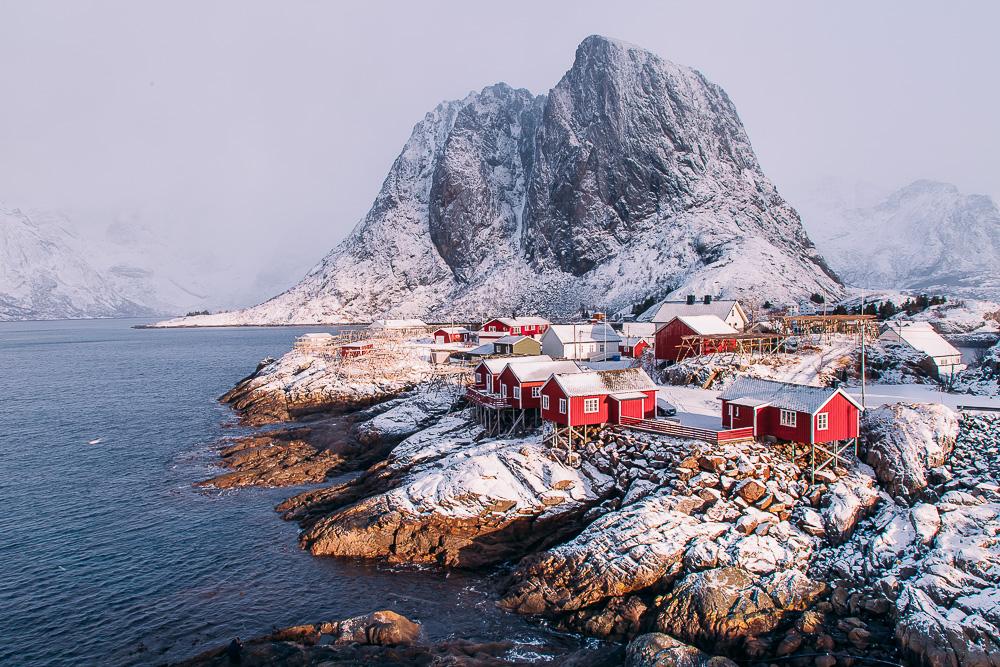
Lofoten is a chain of islands in northern Norway, about 200 kilometers north of the Arctic Circle. Jagged peaks rise directly from the sea, red and yellow fishermen's houses on stilts sit over the water, and narrow straits between islands turn violent in strong winds. In winter, snow-capped mountains contrast with dark unfrozen fjords in a way that makes photographers stop and stare for a long time. The islands are connected by bridges and tunnels, so you can drive the entire archipelago in a day. But the appeal is in stopping: in the fishing villages like A, Nusfjord, and Reine, in the views from elevated roads, in the silence that settles over the archipelago when the weather turns still.
November through February offers the best conditions for northern lights in Lofoten, simply because nights are long. In November you have roughly 17-18 hours of darkness, which gives plenty of opportunity for aurora activity to be visible. The best conditions are clear skies and solar activity. Most people spend 5-7 nights hoping for at least one or two good aurora nights, and in November those odds are reasonable. The setting matters as much as the aurora itself. Watching the northern lights reflect in the still water of a fishing village bay, framed by lit wooden houses, is a different experience from seeing them over flat terrain.
Reinebringen is the viewpoint above the village of Reine, one of the most photographed spots in Norway. The hike takes about an hour, gaining roughly 400 meters of elevation. In summer it's crowded. In November you might have it to yourself. The view from the top, the village below, the fjord threading between peaks, islands stretching into the distance, is worth every step including the icy patches that require care in winter conditions.
The Sami are the indigenous people of northern Scandinavia. Visiting a Sami camp, learning about reindeer herding, traditional joik singing, and the relationship between these communities and the land, adds real depth to any Arctic trip. It's not a museum experience. The people running these camps share their culture on their own terms.
The most compelling reason to visit Lofoten in November specifically is what comes after. The drive or ferry to Skjervoy puts you within reach of orca season in the northern fjords, and the two experiences complement each other in a way that feels intentional. A few days in the landscape, then three or four days on the water with orcas. The contrast between mountain stillness and the chaos of carousel feeding is part of what makes the combination so memorable.
.png)


.svg)