
Explore curated trips across the globe, designed for every type of traveler.
Thinking about capturing your underwater experiences but not sure which camera to choose? This guide breaks down five popular options—from compact action cams to professional mirrorless cameras—so you can pick the one that actually fits how you want to shoot. We'll cover what each camera does well, where it falls short, and who should consider it.
You're floating beside a whale shark. Sunlight filters through the water. The moment is perfect, and you want to capture it. But which camera should be in your hands?
The answer depends on what matters most to you—ease of use, creative control, or image quality. Here's an honest look at the cameras we see (and use) underwater all the time.
The GoPro Hero 13 is what most people picture when they think "underwater camera." It's compact, tough, and remarkably simple to use.
What it does well:
The Hero 13 shoots 5.3K video at 60fps and 4K at 120fps, giving you smooth footage and flexibility in editing. HyperSmooth 6.0 stabilization means your footage stays steady even when you're not. The camera is waterproof to 33 feet without any housing, so you can literally grab it and go.
The touchscreen works above water, and while it doesn't function underwater, the physical buttons are easy to find and press. Battery life continues to improve with each generation—you'll get through most dives on a single charge.
Where it struggles:
Low-light performance remains the Hero 13's main weakness. In deeper water or overcast conditions, footage can look grainy. The fixed lens means you're stuck with that wide-angle perspective. And while 5.3K sounds impressive, the sensor is small compared to larger cameras.
Color correction helps, but you'll notice the blues and greens dominating your footage at depth. Filters can improve this, but they're an additional investment.
Who should consider it:
If you're new to underwater photography, the GoPro makes sense. It's forgiving, intuitive, and tough enough to handle beginner mistakes. You clip it on, hit record, and focus on the experience rather than camera settings.
It's also ideal for travelers who want one camera for everything—snorkeling, hiking, skiing. The versatility is hard to beat at this price point ($400).
The Ace Pro 2 is Insta360's answer to the GoPro, but with some clever upgrades that make a real difference underwater.
What it does well:
The Leica SUMMARIT lens and large 1/1.3" sensor deliver noticeably better image quality than standard action cams. PureVideo technology excels in low light—this camera handles deeper dives and murky conditions better than the GoPro.
The flip touchscreen is genuinely useful for framing shots, and the AI-powered features simplify settings. Underwater Mode produces vivid, true-to-life colors straight from the camera without extensive post-processing. Battery life runs about 100 minutes at 4K30fps.
Like the GoPro, it's waterproof to 33 feet without a housing, with a dive case available for deeper work.
Where it struggles:
While better than GoPro in low light, it still can't match what a larger sensor delivers. The AI features are helpful but sometimes make choices you wouldn't. And if you're already invested in GoPro mounts and accessories, switching means buying new gear.
Who should consider it:
If you want action cam simplicity but care about image quality, the Ace Pro 2 sits in a sweet spot. It's particularly good for people who shoot in varying light conditions or want better results without learning complex camera settings.
The flip screen and AI features make it appealing for solo travelers who want to frame themselves in shots.
The X5 represents the cutting edge of 360 cameras. Instead of choosing what to film, it captures everything around you in stunning quality. You decide what the shot is later, during editing.
What it does well:
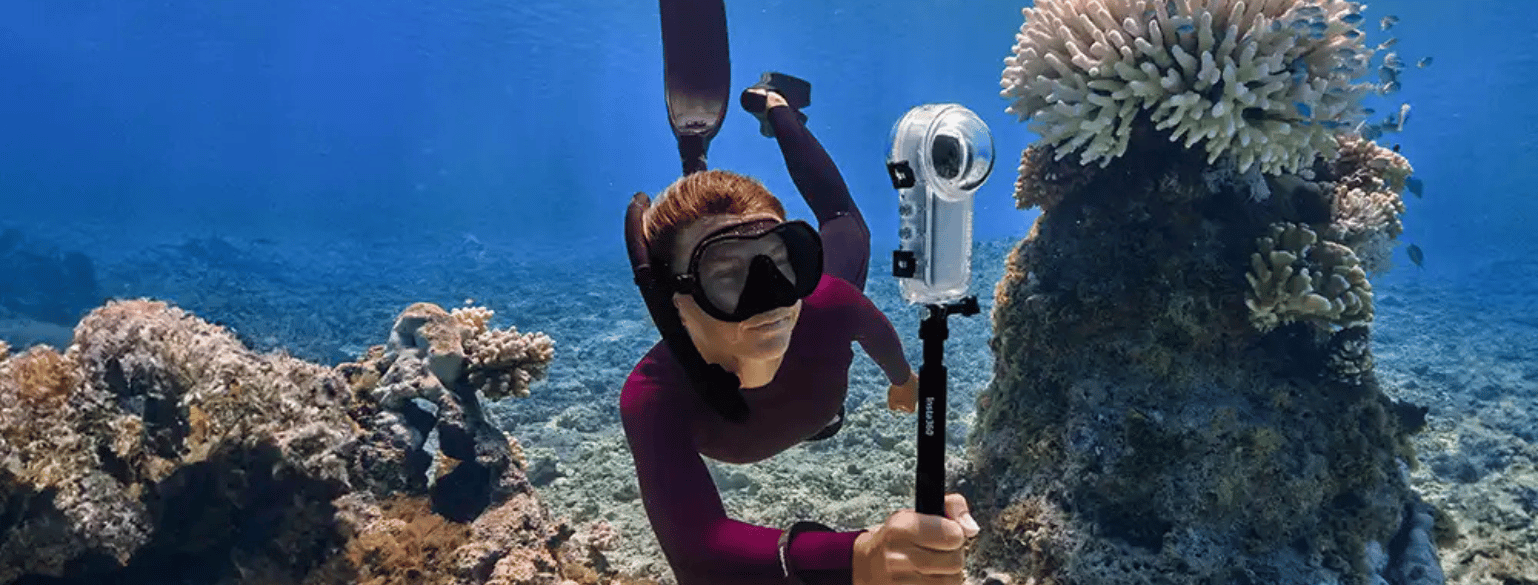
8K 360-degree video means you're recording in every direction simultaneously. Miss the whale shark passing behind you? You didn't actually miss it—it's in your footage. The Invisible Selfie Stick creates perspectives that look impossible, like you're filming yourself from a drone.
PureVideo Mode uses AI denoising for exceptional low-light performance—better than any other 360 camera. The battery lasts an incredible 185 minutes in Endurance Mode. Replaceable lenses mean scratches aren't a disaster.
The editing app is remarkably good. AquaVision color correction handles underwater footage automatically. FlowState stabilization keeps everything smooth. And because you're capturing everything, you can reframe shots afterward—zooming in on details you didn't even notice during the dive.
Where it struggles:
The learning curve is steeper than traditional action cams. You need to understand how 360 shooting works, how to position the camera, and how to edit the footage. File sizes are massive—8K 360 video eats through storage quickly.
While low-light performance is excellent for a 360 camera, it still can't match a dedicated mirrorless camera. And the camera requires the Invisible Dive Case for proper underwater use to avoid stitching errors.
Who should consider it:
If you're comfortable with technology and enjoy the editing process, the X5 opens creative doors that traditional cameras can't. It's particularly appealing if you want unique perspectives or if you're creating content for social media.
The X5 works best for people who shoot intentionally and are willing to invest time in post-production. You're not just capturing moments—you're crafting how people experience them.
Our take: This is one of the cameras our Maui photographer uses on expeditions. The 360 capability means we never miss a moment, and the creative possibilities are endless for showcasing marine encounters.
The Sony A7SIII is a different animal entirely. This is a full-frame mirrorless camera built for serious video work, and it shows in every spec.
What it does well:
Low-light performance is extraordinary. The 12MP sensor prioritizes sensitivity over resolution, which means clean footage in conditions where other cameras struggle. Shooting at ISO 12,800+ without excessive noise changes what's possible underwater.
4K video at 120fps gives you cinematic slow motion. 10-bit 4:2:2 internal recording means exceptional color depth and flexibility in color grading. S-Log2 and S-Log3 profiles preserve 15+ stops of dynamic range. No recording time limits. No overheating issues underwater.
The autofocus system with 759 phase-detection points is reliable and fast. Five-axis in-body stabilization helps, though you'll still want stable technique for professional results.
Where it struggles:
This is not a grab-and-go camera. You need to understand exposure, white balance, picture profiles, and color grading. The learning curve is significant. Protecting this camera underwater requires a serious investment in housing and ports (we'll cover that in another article).
The camera body costs around $3,500. It's larger and heavier than action cams. You'll need additional lenses. And 12MP means this isn't ideal if you primarily shoot stills—though for video work, it's exceptional.
Who should consider it:
If you're serious about underwater videography and already comfortable with manual camera controls, the A7SIII delivers results that action cams simply can't match. The footage has a quality that looks professional because it is professional.
This camera makes sense for people creating content for clients, building a portfolio, or refusing to compromise on image quality. You'll spend time learning it, but the results justify the effort.
Our take: Our Maui photographer shoots all expedition videos on the A7SIII. The low-light performance is critical when filming in deeper water or during dawn/dusk encounters, and the color science makes post-production significantly easier.
While the A7SIII excels at video, the A7CR is built for photographers who want the highest image quality in a relatively compact full-frame body.
What it does well:
61MP resolution gives you incredible detail and flexibility for cropping. The image quality is stunning—rich colors, excellent dynamic range, and clean files even at higher ISOs. The compact body is significantly smaller than other full-frame cameras, making it more manageable underwater.
The autofocus system is excellent, with reliable subject tracking for moving marine life. In-body stabilization helps with handheld shooting. And while it's primarily a photo camera, it shoots respectable 4K video when needed.
Where it struggles:
61MP files are large—you'll fill memory cards and hard drives quickly. The high resolution demands sharp technique; any camera shake or slight misfocus becomes obvious. It's more expensive than the A7SIII at around $3,000 for the body alone.
Like all mirrorless cameras, it requires underwater housings, ports, and often strobes for proper underwater photography. The total investment adds up quickly.
Who should consider it:
If your priority is capturing stunning still images of marine life and you're already experienced with manual photography, the A7CR delivers exceptional results. It's the camera for people who want to create prints, build portfolios, or capture wildlife with the highest possible quality.
The smaller size compared to other full-frame cameras is a genuine advantage underwater, where bulk matters more than on land.
Our take: Our Maui photographer uses the A7CR for all expedition photography. When you're photographing whale sharks, manta rays, and other marine life, the resolution and image quality make a real difference in capturing those moments with the detail they deserve.
Here's the practical reality: most people should start with either a GoPro Hero 13 or Insta360 Ace Pro 2. Both are affordable, relatively simple, and capable enough for the majority of underwater shooting. You'll get good results without needing to understand complex camera theory.
The Insta360 X5 appeals to a specific type of person—someone who loves the creative process and wants footage that stands out. If you're already editing videos and enjoy experimenting, the X5 offers possibilities that traditional cameras don't.
The Sony cameras (A7SIII and A7CR) are for people who know they need them. If you're asking whether you need professional-level tools, you probably don't yet. But if you're already shooting seriously and underwater work is important to you, these cameras deliver results worth the investment.
In our photography workshops, we work with all of these cameras. We teach beginners on GoPros and Insta360 Ace Pros, help them explore creative possibilities with the X5, and show more advanced shooters how to maximize the Sony cameras' capabilities.
Our expedition photographer shoots with the Sony A7SIII for video, the Sony A7CR for photos, and the Insta360 X5 for creative 360 content. This combination covers everything from cinematic video to high-resolution stills to unique perspectives that make viewers feel like they're in the water with us.
But the best camera is the one you'll actually use and feel comfortable with. Start where you are, not where you think you should be. You can always upgrade later once you know what you actually need.
Ready to improve your underwater photography? Join us in the Maldives or Mexico where our optional photography workshops cover everything from camera settings to capturing wildlife behavior—whether you're shooting on a GoPro or professional Sony. Explore our expeditions.
At Maui, we believe the best travel stories start with the people you meet, not just the places you go. Join us, and become part of something bigger than just another trip.
📩 Questions? Reach out at info@mauitravel.io – we'd love to hear from you.
.png)


.svg)